
How to read a GIA diamond certificate for engagement ring selection
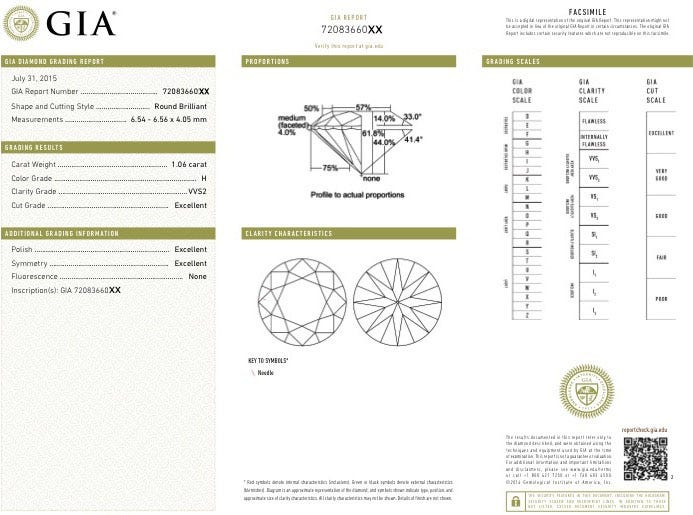
Reading a diamond certificate is not difficult at all. Once you understand the meaning of each section, it becomes much easier to compare prices between different diamonds, as every line affects the diamond's value. Let’s look at each line.
GIA Report Number: This number acts as an ID for each diamond, allowing you to know which specific diamond the details on the certificate belong to. This number is laser-inscribed on the girdle of the diamond and can be seen with a 10x magnification loupe, or by an experienced person using a portable diamond magnifier. **In the image, the admin has removed the last two digits and replaced them with XX.**
Shape and Cutting Style: This section specifies the shape of the diamond. In the example, "Round Brilliant" means this diamond is a round, brilliant-cut stone (brilliant cut is the standard modern cutting style featuring 57–58 facets).

Measurement: This section specifies the diamond's dimensions—width, length, and depth—in millimeters.
Carat weight: This indicates how many carats the diamond weighs. Another easy way to verify if you don’t have a jeweler’s loupe is to weigh it to see if it matches the certificate. Prices differ significantly based on size, as larger diamonds are rarer. One carat is equal to 100 points; anything smaller is referred to in points.
For example, 0.50 carats equals 50 points.
0.30 carats equals 30 points.

Color Grade: This refers to the color of the diamond. It begins at D (the highest grade) and goes down through E, F, G, and all the way to Z (the range of "white" diamonds). On the right side of the certificate, there is a color scale for reference. The certificate above shows H color.
The color grade does not affect the diamond's brilliance; it simply refers to its color or "whiteness." We recommend choosing a grade of 96 (H) or higher if you want to avoid a yellowish tint.

Clarity grade: This is the clarity of the diamond. This stone is VVS2. We recommend grades from VS1 up to FL because blemishes are not visible to the naked eye and require at least 10x magnification to be seen. The table below shows the characteristics visible at each clarity grade under 10x magnification.
However, if you want to stay within a budget, VVS1-VS2 grades are still very beautiful.

Cut grade: This is a very important factor, though many people often overlook it in favor of color. The cut grade refers to how well the diamond's proportions allow it to reflect light (or its sparkle). The grades are Excellent, Very Good, Good, Fair, and Poor. This diamond is graded Excellent, which is the best.
Polish: This grade refers to the smoothness and finish of the diamond's surface. It follows the same grading scale as the Cut grade. This example is also graded Excellent.
Symmetry: This refers to the precision of the shape and the alignment of the facets, which also affects how the diamond reflects light. This example is graded Excellent.
When all three factors—Cut, Polish, and Symmetry—are graded Excellent, the diamond is referred to as Triple Excellent (3EX).
At Gems Heritage, all our round diamonds are 3 Excellent, guaranteeing that they are as beautiful and brilliant as possible.

Fluorescence: This specifies whether the diamond emits light when exposed to UV light. Typically, diamonds with no fluorescence (None), like in this example, are more expensive than those that do. If a diamond has high fluorescence, its price may be lower as it can sometimes affect the stone's appearance, potentially making it look cloudy, though this is not always the case and varies from stone to stone.

Inscription: This refers to the text laser-inscribed by GIA on the girdle, which starts with "GIA" followed by the report number.
Some certificates also list "Clarity characteristics," which detail the specific types of blemishes present in the diamond, such as pinpoints, clouds, feathers, and others.
For larger diamonds, the certificate will include a diagram of the front and back of the stone, with the locations of these characteristics marked with symbols and explained in the legend below.
Now you can easily read a diamond certificate and better understand each detail. Buying a diamond is no longer a difficult task! :)